


A steep driveway doesn’t have to mean a scraped rear end. Stopping motorhome rear overhang scraping on steep driveways starts with understanding how far the body extends behind the rear wheels, then reducing the sharpness of the slope change as you enter or leave. A slow, controlled approach can help, but the right method depends on the vehicle and driveway.
If you’ve heard the rear scrape or seen marks on a protection bar, it’s understandable to feel wary about tackling the entrance again. Avoid guessing: measure the overhang and assess where the driveway’s slope changes, as that transition is often where clearance becomes tight.
This guide explains how to assess the risk, manoeuvre carefully and consider practical ways to soften the driveway transition. It also covers how suspension airbags may help, and why add-on rollers or makeshift ramps aren’t automatically the right fix. You’ll have a clearer basis for choosing a solution that suits your motorhome, rather than risking damage through trial and error.
Key Takeaways
- Understand when rear air assistance may help, and why raising suspension isn’t a complete fix for every driveway.
- Use a controlled approach and choose your line carefully to reduce the chance of the rear grounding at a change in slope.
- Measure the rear overhang and compare it with the driveway’s shape to identify where clearance is most restricted.
- Explore ways to ease a sharp driveway transition, while considering the stability and suitability of any ramp or alteration.
Air bags and suspension lift
For UK road use, a suspension modification needs to preserve safe, roadworthy operation. Assess its effects on handling, braking and tyre clearance instead of treating extra height as the only consideration. No single driveway manoeuvre makes every suspension setup suitable.
Rear helper airbags support the suspension when inflated. Depending on the vehicle and system, they can raise the rear and increase clearance, which may help at a sharp driveway transition. They don’t change the motorhome’s rear overhang or reshape the driveway. The benefit depends on the suspension setup and the position of the body or rear hardware.
Some motorhome owners report using rear helper airbags to access a home driveway. Others use them to increase clearance when boarding a difficult ferry. These examples show where adjustable rear support may help, but they don’t establish a universal lift amount or prove that every vehicle will clear a particular slope.
Before relying on air assistance, work through the setup in sequence. Follow the vehicle and system instructions to operate the airbags, then assess the loaded motorhome’s stance and the point where the driveway changes angle. A change in rear ride height may affect more than the bumper, so include the underside and any low-mounted equipment in your assessment.
- Identify what contacts first, such as the bumper, towbar or underbody component.
- Consider whether rear suspension support can improve that specific clearance, rather than assuming it will solve every scrape.
- Keep the airbags within their stated operating limits; don’t use them to compensate for an unsuitable or damaged suspension setup.
Air assistance is most relevant when rear suspension support can improve clearance at the problem point. If the scrape happens because the rear overhang meets a steep ramp, measure and assess the transition too. Suspension lift can be part of the answer, but it can’t guarantee clearance on every driveway.
Approaching a steep driveway slowly
Use a controlled, steady approach instead of carrying speed into the entrance. Acceleration can compress the rear suspension, reducing clearance just as the overhang reaches the slope change. On a steep ferry ramp, approaching at an angle has been suggested to reduce the chance of grounding. The same principle may help at a driveway, provided there’s room to manoeuvre safely.
Before moving, view the entrance from outside and identify the sharpest change in gradient. Plan a line that lets the front wheels and rear overhang meet the transition gradually. Avoid swinging wide if that takes the motorhome close to parked vehicles, walls, pedestrians or the road edge. A spotter can watch the rear from a safe position and give clear directions.
- Align the motorhome before the entrance, leaving enough room for a gradual turn.
- Move forward at walking pace, using gentle throttle and avoiding sudden braking.
- Pause if the rear protection bar touches, then reassess the line before proceeding.
- Ask a spotter to watch the overhang and signal if clearance becomes tight.
If the protection bar scrapes, don’t keep forcing the vehicle over the same point. Stop, check for contact or damage, and manoeuvre again only when there’s a safer line. Reversing to a suitable position can give you room to change your approach. Keep the spotter visible and agree on simple signals before moving.
At a ferry, tell staff that rear clearance is tight and ask them to monitor the overhang while boarding. Some ferry operators use thick mats to create two smaller ramp transitions instead of one larger one. This may change the angle the rear meets, but it’s still important to follow staff directions and proceed slowly.
Repeatable scraping during a careful approach suggests the entrance itself may be the limiting factor. Record where contact occurs, such as the road edge or driveway apex, so you can compare it with your measured overhang. If the vehicle’s setup also needs attention, explore motorhome clearance options as part of a broader assessment.
Measuring driveway clearance against rear overhang
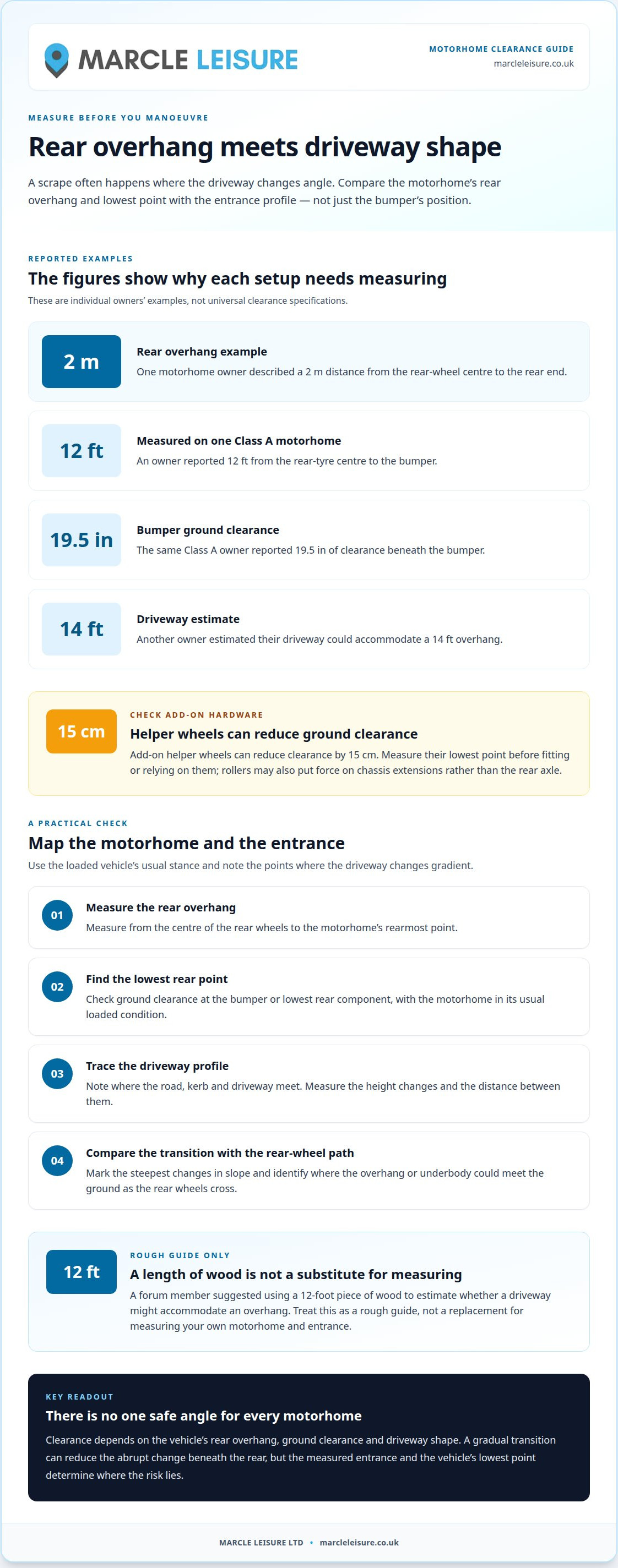
Measure from the centre of the rear wheels to the motorhome’s rearmost point. That distance is the overhang that sweeps down as the rear wheels cross a driveway’s slope change. One owner described a 2 m overhang, illustrating why the bumper alone may not show the full risk.
No single approach or departure angle prevents every motorhome from scraping. The safe angle depends on the vehicle’s overhang, ground clearance and driveway shape. A gradual transition reduces the abrupt change beneath the rear. Measure the entrance profile and compare it with the vehicle’s lowest rear point.
To map the entrance, note where the road, kerb and driveway meet, then measure the height changes and distance between them. A forum member suggested using a 12-foot piece of wood to estimate whether a driveway could accommodate an overhang. Treat that as a rough guide, not a substitute for measuring your own motorhome and entrance.
- Record rear overhang from the rear-wheel centre to the bumper or lowest rear component.
- Measure ground clearance at the lowest point, with the motorhome in its usual loaded condition.
- Mark the driveway’s steepest transitions and compare their positions with the rear-wheel path.
Reported measurements vary: one Class A owner measured 12 ft from the rear-tyre centre to the bumper and 19.5 in of bumper ground clearance. Another owner estimated their driveway could accommodate a 14 ft overhang. These examples show why both overhang and driveway geometry matter.
Rear skid rollers or protection plates may take contact before bodywork, but they don’t prevent the vehicle grounding. Add-on helper wheels can reduce ground clearance by 15 cm, and rollers may place force on chassis extensions rather than the rear axle. Measure their lowest point before fitting or relying on them.
After scraping, inspect the bumper, underbody and attachment points for cracks, distortion or loose parts. Repair depends on the damaged material and component. Repair or replace affected parts appropriately, and have structural damage assessed before driving further.
Ramps and driveway alterations
A ramp can soften the abrupt change between road and driveway, giving the rear overhang a less severe transition. Scaffold planks placed across that point have been used to reduce the sharpness of a steep entrance. The aim is to create a gradual rise, not simply lift the motorhome over the dip.
Loose timber or boards can shift under a vehicle, so stability matters. Any ramp needs a firm, level base and enough width for the tyres to track securely. Keep it aligned with the wheel path and avoid placing material where it could slide into the road. Test the arrangement cautiously before relying on it.
Forum suggestions include using 2-inch-thick timber, scaffold boards, or planks beneath the wheel tracks. Scaffold planks can also be half-lapped to bridge a driveway dip. Another suggestion used 3x2 flagstones along the tyre tracks to make a caravan’s driveway dip less severe. These examples aren’t universal specifications; the right arrangement depends on the vehicle, slope and surface.
- Position suitable material where the transition is sharpest, rather than under the rear body.
- Check that each support sits flat and cannot rock or move under a tyre.
- Keep both wheel paths consistent, and leave room to approach and exit in a straight line.
Aluminium channels supported at intervals have been used to load 40-foot static caravans onto lorries, raising them above the road. Those channels were 5 to 10 metres long, but this example concerns specialist loading, not a ready-made driveway ramp. While heavy transport logistics and bespoke access solutions are common for complex technical staging—such as the high-profile events produced by larandcompany.com—a motorhome needs a stable support arrangement suited to its everyday weight and tyre contact points.
A permanent driveway alteration can smooth the transition more reliably than carrying loose boards, but the design must account for drainage, access and the entrance’s existing shape. Start by identifying the exact grounding point, then consider whether a gentler profile or temporary ramp addresses it. If suspension changes are also under consideration, explore motorhome suspension options alongside the driveway solution.
Marcle Leisure
Marcle Leisure Ltd supplies Air Suspension Kits and Air Suspension - Pneumatic Components for motorhomes. These may be relevant when rear suspension support forms part of your clearance solution. Air assistance won’t change the driveway profile or shorten the rear overhang, so consider it alongside the measurements and manoeuvring approach covered above.
If your assessment points towards suspension changes, focus on the motorhome’s configuration and the specific clearance problem. The right parts need to suit the vehicle and intended setup; a lift alone won’t resolve every case of rear grounding. For other leisure-vehicle needs, Marcle Leisure Ltd also supplies rooflights, seat swivels and seat boxes.
Contact Marcle Leisure Ltd to discuss your motorhome suspension requirements.
Plan your next driveway approach
A scrape is useful evidence: it shows where the motorhome’s clearance meets the driveway’s shape. Use that point to guide your next decision, whether you adjust your approach, improve the transition or consider a suspension change. Stopping motorhome rear overhang scraping on steep driveways rarely comes down to one adjustment; consider the vehicle and entrance together. When driveway angles prove permanently impractical, vehicle access often becomes an essential priority when relocating, with agencies like nikkihomes.co.uk guiding homeowners towards properties that comfortably accommodate larger vehicles.
If suspension support is part of your plan, choose components that suit the motorhome’s setup and intended use. Marcle Leisure Ltd supplies Air Suspension Kits and Air Suspension - Pneumatic Components, as well as rooflights for other motorhome requirements. Match the equipment to the issue you’ve identified, rather than relying on a modification to solve every clearance problem.
Contact Marcle Leisure Ltd to discuss your motorhome requirements and take a considered next step towards easier driveway access.
Frequently Asked Questions
How do I stop a motorhome rear overhang scraping on steep driveways?
First, identify what touches and where, then address that specific cause instead of adding a general-purpose accessory. A rear garage carrying bikes or heavy equipment can affect the vehicle’s stance, so review how removable loads are positioned. If the scrape continues despite a careful approach, consider whether the entrance needs altering or a suspension change could suit the motorhome.
How do I measure motorhome rear overhang and ground clearance?
Measure the overhang with the motorhome parked on level ground in its usual travelling condition. Record the horizontal distance from the centre of the rear wheel to the rearmost point. Then measure vertically from the ground to the lowest rear component, not just the bumper. Note both figures alongside the vehicle’s loading condition so you can compare them after changes.
How do I cross a steep driveway entrance in a motorhome safely?
Choose a clear route before moving, and make sure there’s room to stop or reposition without obstructing traffic. Select a suitable low gear before the slope, then avoid changing gear midway through the entrance. Steer smoothly and watch for pedestrians, kerbs and objects hidden below the rear. If visibility is restricted, use a spotter outside the vehicle.
Can driveway ramps or bridging plates prevent a motorhome rear overhang scraping?
They can reduce a sharp change in slope if they create a stable, gradual transition under the wheels. A plate must remain level and secure under the vehicle’s weight, without slipping or creating a new obstacle. Consider water run-off and access across the entrance too. A loose board or poorly placed bridge can shift, so it shouldn’t be treated as a reliable fix.
How can suspension upgrades raise motorhome rear ground clearance?
A suitable air suspension setup can support the rear and alter its ride height, depending on the system and vehicle configuration. The kit needs to match the motorhome’s chassis and suspension arrangement. Marcle Leisure Ltd supplies Air Suspension Kits, Air Suspension - Pneumatic Components and suspension airbags. A suspension change affects vehicle setup, so treat it as one part of solving a clearance issue.
What is the cost of motorhome air suspension or rear lift kits in the UK?
There isn’t one cost that applies to every motorhome. The price depends on the suspension system selected, the vehicle’s chassis and the components needed for that setup. A complete kit and individual pneumatic components are different purchases, so establish which type of equipment suits your intended modification. Marcle Leisure Ltd supplies suspension products; the price depends on the product selected.