


A lorry’s airflow can pull a motorhome towards it, then push it away as the vehicles pass. To understand how to eliminate body roll when lorries overtake a motorhome, first reduce your exposure to that airflow: hold a steady speed, leave room within your lane and avoid abrupt steering.
The sudden movement can feel unsettling, particularly when the motorhome sways as the lorry draws level. It comes from air moving around the larger vehicle, not simply from its size or weight. This guide explains how the changing air pressure affects your motorhome, what to do as a lorry passes and how suspension can influence the vehicle’s response. You’ll also find practical ways to manage buffeting without making sudden changes to your driving.
Key Takeaways
- On UK motorways and dual carriageways, lorries are restricted to 60 mph, according to the UK Department for Transport.
- A motorhome’s body shape and rear overhang can affect how strongly passing lorry airflow is felt.
- Learn how easing off the accelerator as a lorry passes can help reduce time spent in its airflow.
- See how suspension set-up and pneumatic components may be relevant if your motorhome feels unsettled beyond passing manoeuvres.
1. Suction and push forces around large vehicles
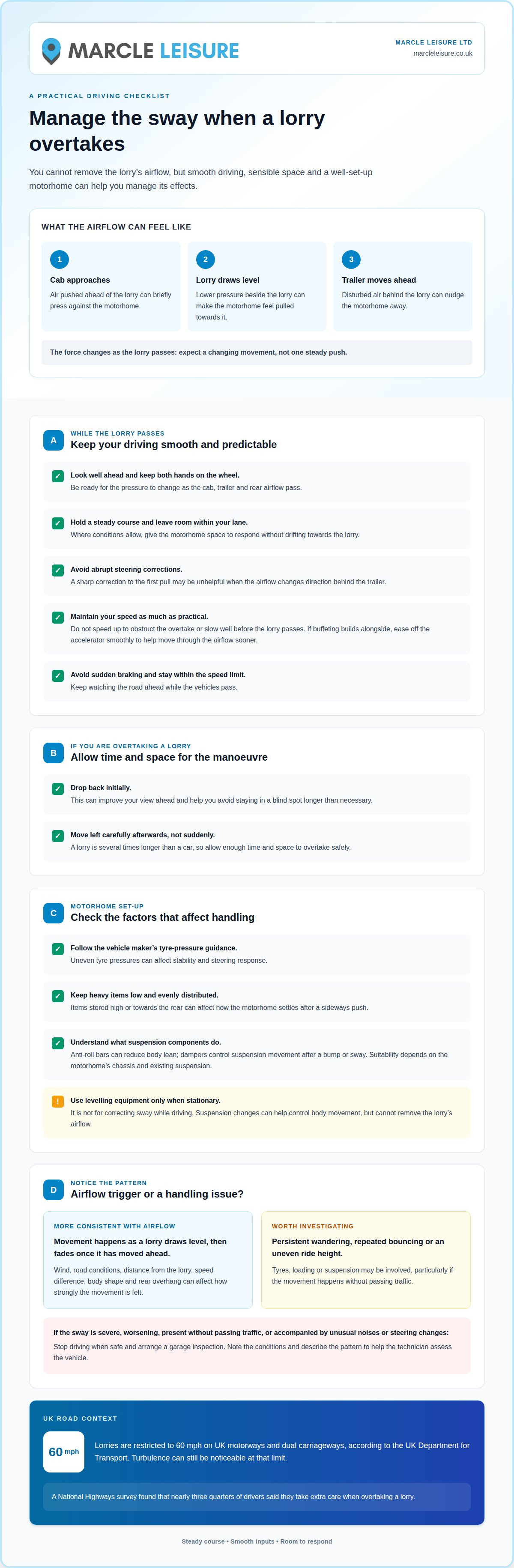
A passing lorry changes the air pressure around a motorhome in stages. As its cab approaches, it pushes air ahead, creating a brief force against the motorhome. When the cab draws level, air moves around both vehicles and pressure beside the lorry can fall, making the motorhome feel as though it is being pulled towards it. As the trailer passes, the airflow shifts again. Disturbed air behind the lorry can then push the motorhome away.
This sequence explains why the steering can feel tugged, then pushed, rather than affected by one steady force. The effect is more noticeable when a large vehicle passes close by, leaving less space between the motorhome and the changing airflow. A towed caravan can also react to pressure changes, with movement transferring through the tow vehicle. The lorry’s weight does not create suction directly; its size and shape displace air as it travels.
Speed affects how quickly the lorry’s airflow reaches and passes the motorhome. In the UK, lorries are restricted to 60 mph on motorways and dual carriageways, according to the UK Department for Transport. Even at that limit, a moving truck can create noticeable turbulence. The difference between its speed and yours, its distance from your vehicle, and crosswinds all affect how strongly the air movement is felt.
Keep your steering inputs smooth as the pressure changes. Avoid a sharp correction in response to the first pull, because the airflow may change direction while the trailer continues past. A motorhome might drift slightly towards a lorry, then be nudged away by the air behind its trailer. Hold a steady course and give the vehicle room within its lane where conditions allow. This helps you manage the changing forces without adding sudden movements of your own.
2. Airflow effects when lorries overtake motorhomes
As a lorry draws alongside, airflow changes along the motorhome’s side and around its rear. The cab and trailer create different pressure zones, so you may feel a brief pull followed by a sideways nudge. Crosswinds can add to the movement, particularly on an exposed road. A long rear overhang can also make a vehicle feel more responsive to passing airflow.
When a lorry overtakes your motorhome, keep a steady course and avoid sudden steering corrections. Maintain your speed as much as practical, rather than accelerating to obstruct the overtake or slowing well before the lorry passes. If buffeting builds alongside, easing off the accelerator smoothly can help you move through the airflow sooner. Avoid sudden braking. Keep within the speed limit and watch the road ahead.
If you’re considering how to eliminate body roll when lorries overtake a motorhome, suspension components can help control body movement, but they cannot remove the airflow. Anti-roll bars can reduce body lean, while dampers control suspension movement after a bump or sway. Suitability depends on the motorhome’s chassis and existing suspension. Tyre pressure and load distribution also affect handling: follow the vehicle maker’s pressure guidance and secure heavy items low and evenly. Levelling equipment is for a stationary motorhome, not for correcting sway while driving.
To assess how to eliminate body roll when lorries overtake a motorhome, note when the movement occurs. Sway that coincides with a passing lorry points to airflow; persistent wandering, uneven ride height or repeated bouncing may indicate a tyre, loading or suspension issue. If the sway is severe, worsening, present without passing traffic, or accompanied by unusual noises or steering changes, stop driving when safe and arrange a garage inspection. Record the conditions and describe the pattern to help the technician assess the vehicle.
3. Why does a motorhome sway when overtaken by a lorry?
Air pressure changes across a motorhome’s broad body can make it move sideways. The effect combines roll, when the body leans, and yaw, when the vehicle turns slightly around a vertical axis. As the lorry passes, these forces act against the motorhome’s suspension and tyres. The steering may feel light briefly, then need a small correction to keep the vehicle tracking straight.
Vehicle shape affects how the movement feels. A tall, wide motorhome presents a larger side area to disturbed air than a low car. The force also acts above the road, so it can make the body lean as well as shift sideways. A long rear section can add leverage behind the rear axle, making movement at the back feel more pronounced than the initial disturbance near the cab.
Load and suspension condition influence the vehicle’s response. Heavy items stored high or towards the rear, for example, can affect how the motorhome settles after a sideways push. Worn dampers may allow the body to keep moving after the lorry has passed, while uneven tyre pressures can affect stability and steering response. These factors do not create the lorry’s airflow, but they can change how the vehicle reacts to it.
Pay attention to the pattern of the sway. If it happens briefly as a lorry draws level and fades once it has moved ahead, airflow is a likely trigger. If the motorhome also wanders on a calm road, bounces after ordinary bumps or sits unevenly, the cause may involve tyres, loading or suspension instead. Record when the movement happens, including wind and road conditions, then describe the pattern during a garage inspection. This gives the technician useful context for assessing the chassis, suspension and running gear, rather than treating every brief movement as the same fault.
When a lorry passes, maintain your speed as much as practical and avoid speeding up to block it. If you’re overtaking, drop back initially to improve your view ahead and avoid staying in a blind spot longer than necessary. Move left carefully afterwards, not suddenly. A lorry is several times longer than a car, so allow enough time and space to overtake safely.
A National Highways survey found that nearly three quarters of drivers said they take extra care when overtaking a lorry.
4. How can I safely reduce motorhome body roll and buffeting while driving?
Prepare before the lorry reaches your motorhome. Keep both hands on the steering wheel, look well ahead and leave room to adjust your position within the lane. If road markings, traffic and visibility allow, move slightly left to increase the distance from the passing vehicle. Don’t swerve or cross the lane edge. A measured position gives you more space from the lorry’s airflow without creating another hazard.
As the lorry draws level, hold a steady course and avoid sharp steering inputs. Maintain your speed as much as practical, rather than accelerating to obstruct the overtake or slowing well before it passes. If buffeting builds alongside, ease off the accelerator smoothly, not with sudden braking. For drivers asking how to eliminate body roll when lorries overtake a motorhome, this calm response helps limit abrupt movements while keeping attention on the road ahead.
Once the lorry has passed, allow the disturbed air to settle before changing position or speed significantly. Don’t steer sharply right as soon as its cab is ahead; the trailer and wake may still affect your motorhome. If you’re towing a caravan, use gentle inputs to avoid unsettling both vehicles. Leave enough space around you to respond calmly if the caravan moves.
Plan for the conditions as well as the passing vehicle. On an exposed road in crosswinds, adjust your speed appropriately while staying within the posted limit, and increase your following distance if traffic limits your options. If the motorhome feels too unsettled for a safe pass, don’t attempt to overtake. Knowing how to eliminate body roll when lorries overtake a motorhome also means noticing whether movement continues after the pass. Repeated sway away from lorries calls for attention to the vehicle’s handling, not just a change in passing technique.
Moving left within the lane can increase the distance between an RV and the airflow from an overtaking vehicle, provided it remains safe to do so. When a lorry overtakes an RV, easing off the accelerator can help the RV get out of the airflow danger zone sooner. Drivers towing an RV should pass through the area alongside a lorry as quickly as possible, using controlled inputs rather than lingering beside it or making a sudden manoeuvre. Bracing against turbulent buffeting on long drives can also cause noticeable physical tension and muscular stiffness, where practices such as Functional Movement Physio can help drivers recover comfort and mobility through specialist therapies.
Marcle Leisure
Marcle Leisure Ltd supplies air suspension products for motorhome owners considering changes to their vehicle's suspension set-up. If body roll or unsettled handling persists beyond lorry overtakes, Air Suspension Kits, Air Suspension - Pneumatic Components and airbags for suspension are options to explore alongside the vehicle's existing specification. The right parts depend on the motorhome and its suspension arrangement, so choose a solution suited to your vehicle rather than assuming one component will remove every effect of passing airflow.
Use the driving techniques above to manage buffeting on the road, and consider suspension products when assessing the vehicle's handling more broadly. Contact Marcle Leisure Ltd to discuss your motorhome and the available suspension options.
Make your next journey feel more controlled
On your next journey, notice whether the movement is limited to lorry passes or also occurs on open, windy roads. That distinction gives you a practical starting point for discussing your motorhome’s handling and deciding whether its current set-up suits the way you travel. Knowing how to eliminate body roll when lorries overtake a motorhome is less about finding a single fix and more about combining safe driving habits with a vehicle that responds predictably. Planning restful stopovers along your route also helps counter the fatigue of handling buffeting on busy motorways; for instance, travellers heading towards the South West can take a relaxing break at The Corner House Hotel to recharge before continuing their journey.
If buffeting continues to affect your confidence, take note of the conditions and describe them when seeking advice. A clear account of when the motorhome moves can help focus the discussion on the issue that matters to you. Marcle Leisure can help you explore relevant leisure-vehicle equipment. Contact Marcle Leisure for advice and take a considered next step towards more settled touring.
Frequently Asked Questions
Can motorhome suspension upgrades reduce body roll from passing lorries?
A suitable suspension upgrade can help control body movement, but it cannot remove the airflow forces from a passing lorry. The improvement depends on the motorhome’s chassis, current suspension and loading. If the vehicle continues to rock after the lorry has passed, for example, suspension behaviour may be part of the issue. Match any upgrade to the vehicle rather than treating it as a complete fix for buffeting.