


More suspension support does not, by itself, increase a motorhome’s legal payload. In the UK, up-plating means raising the vehicle’s maximum permitted weight with approval and documentation. Motorhome payload upgrade suspension requirements depend on the vehicle: some uprates need no physical changes, while others require suitable suspension, wheels or tyres.
It’s easy to assume that a motorhome sitting more level or feeling steadier can carry more. But ride comfort and legal weight limits are separate matters. The permitted gross vehicle weight and each axle limit still determine how much the vehicle can carry, whatever suspension is fitted.
This guide explains how payload, gross vehicle weight and axle limits fit together, and what to consider before pursuing an uprate. It also covers how suspension, wheels and tyre load ratings can affect requirements, why weighing a motorhome as it will be used matters, and when an upgrade may be suitable. The aim is to clarify the difference between improving the ride and gaining approved payload.
Key Takeaways
- Weigh the motorhome with its intended occupants and kit, then assess each axle separately to spot where capacity is most constrained.
- Suspension, wheels and tyres may need changes for an uprate; the requirements depend on the vehicle and its load ratings.
- Semi-air suspension may be relevant where extra rear support is needed, but its role is distinct from approval to carry a higher legal weight.
- According to the Driver and Vehicle Licensing Agency, for a UK motorhome above 3,500 kg and up to 7,500 kg, a driver who passed their test after 1997 needs a separate C1 test.
Motorhome payload limits and weight capacity
A motorhome’s legal carrying capacity depends on its authorised gross weight, actual weight and the limits for each axle. Towing adds another consideration: gross train mass is the maximum permitted combined weight of the motorhome and trailer.
Axle loads, legal limits and licence requirements
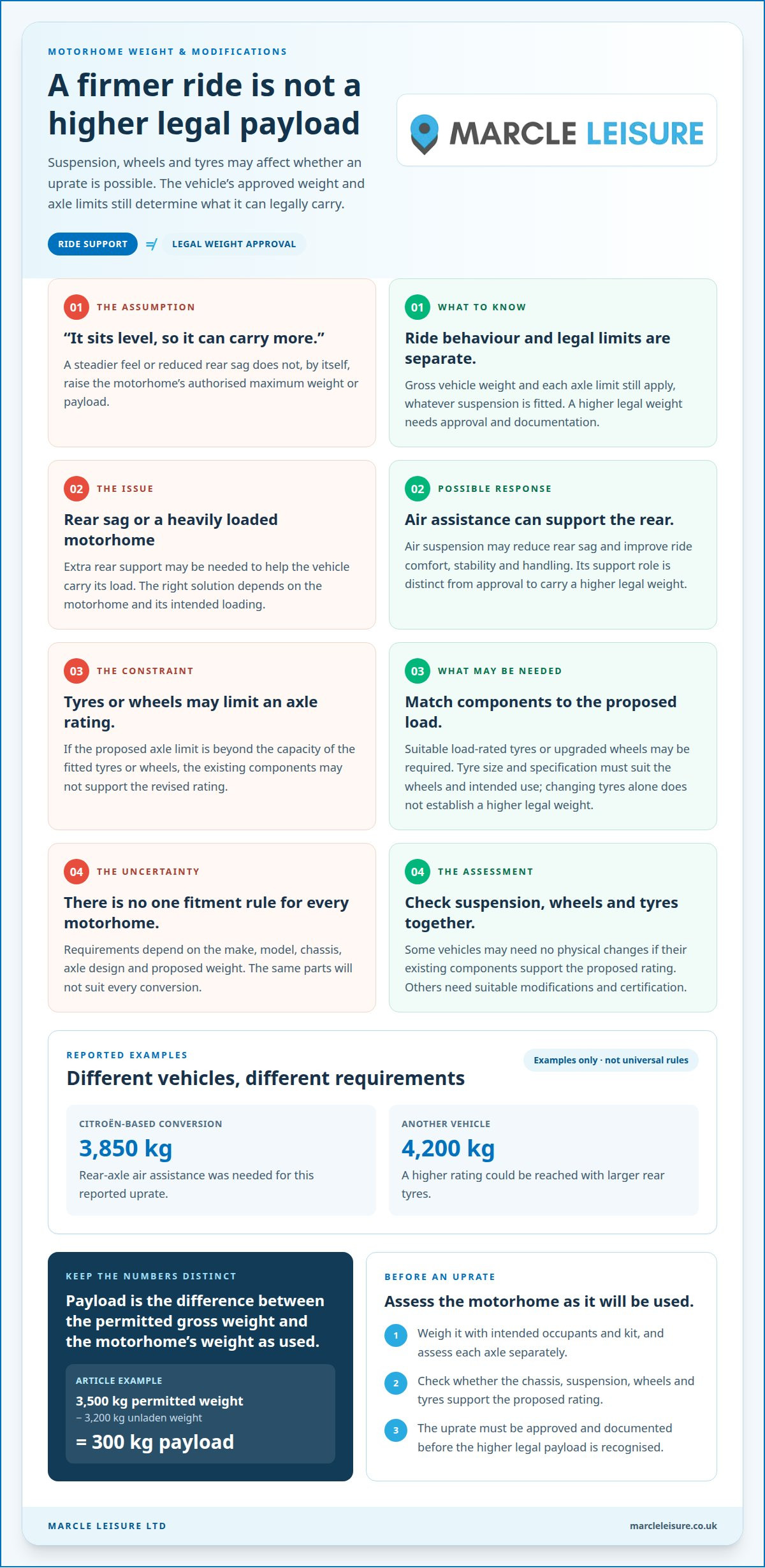
Gross vehicle weight is the legal total weight of the motorhome, including people, luggage and equipment. Payload is the difference between that limit and the vehicle’s weight as it is used. For example, a motorhome weighing 3,200 kg unladen with a permitted weight of 3,500 kg has 300 kg of payload.
Check the gross limit and each axle limit separately. A weight plate might show 1,850 kg for the front axle and 2,000 kg for the rear; those limits do not replace the gross vehicle weight ceiling. The axle limits can add up to more than the gross limit, but the vehicle must remain within both its gross and individual axle limits.
According to the Driver and Vehicle Licensing Agency, for a UK motorhome above 3,500 kg and up to 7,500 kg, a driver who passed their test after 1997 needs a separate C1 test. According to the Driver and Vehicle Licensing Agency, an owner may downplate a vehicle to 3,500 kg because of licence restrictions, including reaching age 70 or not having C1 entitlement after passing their test after 1997.
For towing, compare the loaded motorhome and trailer’s combined weight with the vehicle’s gross train mass. This limit is separate from payload and axle capacity, so extra carrying allowance does not automatically mean extra towing capacity.
Uprating costs
The cost of a UK motorhome suspension and weight uprate depends on what the vehicle needs to meet its proposed limits. A paperwork-only uprate differs from one requiring suspension, wheel or tyre changes, so the work and components involved determine the overall cost.
Start by identifying the intended increase and the motorhome’s current axle loads. If the existing chassis, wheels and tyres support the proposed rating, physical changes may not be needed. If an axle or component limits the rating, suitable modifications and certification form part of the assessment. Air suspension alone does not legally raise the maximum authorised mass or payload.
Weighing the motorhome with its intended contents helps identify which axle carries the greatest load. This makes it easier to see what limits the vehicle, rather than assuming a higher gross weight automatically provides useful payload. The uprate must be approved and documented before the higher legal payload is recognised.
Suspension, wheel and tyre modifications
The vehicle’s make, model, chassis and proposed weight determine whether an uprate needs physical changes. Some upgrades can be completed without modifications; others call for suspension changes or wheels and tyres with suitable load ratings. Motorhome payload upgrade suspension requirements are specific to each vehicle, so the same parts won’t suit every conversion.
Suspension options include retaining the existing set-up if it meets the proposed rating, or adding air assistance when more support is needed. Air suspension can help reduce rear sag and improve ride comfort, stability and handling, particularly when the motorhome is heavily loaded. The options address different needs: an uprated rating concerns approved weight, while suspension support affects how the vehicle carries its load.
Reported examples show why requirements vary. One Citroen-based conversion needed rear-axle air assistance for an uprate to 3,850 kg. Another vehicle could have reached 4,200 kg with larger rear tyres. These examples aren’t universal fitment rules. They illustrate how existing axle, suspension and tyre capacity can determine which changes a vehicle needs.
A tyre’s load rating indicates the load it is designed to carry. If the proposed axle limit exceeds the capacity supported by the fitted tyres, replacement tyres with a suitable load rating may be required. Tyre size and specification must also suit the wheels and intended use. Changing tyres alone does not establish a higher legal weight.
Wheel upgrades may be needed if the current wheels are unsuitable for the proposed loading. Consider axle limits alongside wheel and tyre specifications, then establish whether suspension changes are also required. Assessing motorhome payload upgrade suspension requirements means considering these components together, rather than changing one part in isolation.
If rear sag is the practical concern, air assistance may improve support and ride behaviour. If the rear tyres limit the proposed axle rating, tyres may be the key component instead. The motorhome’s specifications and intended load determine which route is appropriate.
Increasing motorhome payload by uprating
Uprating legally increases a motorhome’s official maximum permitted weight. The extra payload depends on the approved rating and the vehicle’s actual loaded weight.
Vehicle and chassis requirements
Before uprating, an engineering assessment considers the motorhome’s make, model, chassis and axle design limits. The proposed gross weight must be supported by relevant vehicle components, including the suspension, wheels and tyres. Some vehicles can be uprated without physical changes; others need modifications to meet the revised limits. Actual axle loads, measured with intended contents, help identify what limits the vehicle.
Uprating process and maximum authorised mass
In the UK, up-plating legally raises a motorhome’s official maximum permitted weight. A specialist engineering assessment determines whether the vehicle can support the proposed rating and whether modifications are needed. The uprate must be approved and documented before the higher legal payload applies. Certification for almost all UK motorhomes requires an accredited specialist company, and the DVLA only accepts up-plating certification from an accredited specialist.
Once the revised weight is certified, the vehicle’s registration details must reflect its approved rating. The insurer must also be notified of the new certified weight before the motorhome is driven at that higher weight. Certification and accurate vehicle records are part of the process, not optional paperwork to complete later.
Payload gains and specialist assessment
A suspension upgrade alone doesn’t determine how much legal payload increases. That gain comes from the approved increase in maximum weight, less the motorhome’s actual weight; the vehicle’s axle limits can still constrain usable capacity. Owner-reported outcomes vary, including an additional 350 kg without vehicle modifications and a 440 kg gain after uprating a Hymer. These examples aren’t a prediction for another vehicle.
To find an appropriate UK specialist, look for an accredited company that assesses the vehicle and provides certification acceptable to the DVLA. The assessment should consider the chassis, axle limits and any required component changes. This provides a route from engineering assessment to documented approval, while showing whether the proposed increase addresses the motorhome’s actual loading needs.
Semi-air suspension as a possible up-plating modification
Semi-air suspension adds air springs to support the vehicle’s existing suspension, commonly at the rear. The air springs help support the motorhome under load, while the original suspension remains part of the system. This may be relevant when the rear sits low or carries a heavy load, but it is not a payload upgrade by itself.
For up-plating, the key question is whether the vehicle’s chassis and components support the proposed weight. An engineering assessment considers the motorhome’s make, model, axle design limits and existing suspension. Semi-air suspension can form part of the physical changes needed for a particular vehicle, but fitting it alone does not increase Maximum Authorised Mass or legal payload.
Its practical role is different from certification. Air assistance can help reduce rear sag and improve ride comfort on uneven roads, stability and handling when the motorhome carries heavy loads. It can also support control when towing. These ride and handling benefits do not allow the vehicle to exceed its approved gross weight or individual axle limits.
A useful assessment starts with the motorhome loaded as it is intended to travel. Weighing each axle shows where the load is concentrated; the specialist then considers the chassis, suspension, wheels and tyres against the proposed rating. If the rear axle is the constraint, the assessment can determine whether semi-air suspension is relevant or another component sets the limit.
The decision should link the modification to the required uprate and its certification. Where semi-air suspension is needed, the fitted system must form part of the vehicle’s assessed configuration. The higher weight becomes legal only after the uprate is approved and documented. Treat suspension support and legal capacity as related but separate checks.
Explore suspension support for your motorhome as you consider the vehicle’s load and intended use.
Marcle Leisure
Marcle Leisure Ltd helps motorhome owners explore suspension options when load support or ride behaviour is a concern. Its range includes air suspension kits, pneumatic components and airbags for suspension, alongside other leisure vehicle equipment.
These products may be relevant when an assessment identifies a need for additional suspension support, but fitting suspension does not itself increase the vehicle’s legal weight limit. Keep the distinction clear: an uprate requires approval and documentation, while suspension components address vehicle support and handling. The right parts depend on the motorhome and its intended use.
If you are considering suspension changes as part of a motorhome payload upgrade suspension requirements assessment, contact Marcle Leisure Ltd to discuss the available options for your vehicle.
Plan your next step with confidence
Before choosing a route, define what you want the motorhome to do differently. Is your priority carrying your usual touring equipment, improving how the vehicle feels under load, or addressing both? A clear aim keeps the decision focused on a practical outcome rather than a modification for its own sake.
Motorhome payload upgrade suspension requirements depend on how the vehicle is built and the result you’re seeking. Keep ride comfort and legal carrying capacity as separate goals when considering options. If your plans change, revisit the decision based on how you actually travel, rather than assuming one modification will answer every need.
Marcle Leisure can help you consider relevant motorhome equipment as you explore the next step. Contact Marcle Leisure about your upgrade to discuss your requirements. A considered approach gives you a clearer starting point and helps you move towards a set-up that suits your motorhome and touring plans.
Frequently Asked Questions
What Is Motorhome Up-Plating?
Motorhome up-plating is the formal process of raising the vehicle’s authorised maximum weight. It changes the permitted rating, not the motorhome’s physical weight or the capacity of every component. For example, a higher vehicle rating is useful only if the axles and fitted equipment can support it. The revised weight must be certified and recorded before the vehicle is used at that rating.
What are the downsides of up-plating?
Up-plating can involve practical trade-offs, particularly if the revised weight affects your licence entitlement or vehicle taxation class. A higher rating may also require changes to tyres, wheels or suspension, depending on the motorhome. Towing arrangements need separate consideration, since a higher vehicle weight does not itself raise the permitted combined weight. Tell your insurer about the new certified weight before driving at it.
What does uprating really mean?
Uprating means formally increasing a motorhome’s permitted weight rating, rather than simply fitting parts that make it feel more supported. A suspension change may address rear sag or ride behaviour, but it does not, by itself, authorise carrying more weight. Treat uprating as an engineering and documentation process: the vehicle must be assessed, the revised rating approved and its records updated before using the increased allowance.
What is motorhome payload and how is it calculated in the UK?
Payload is the weight available for people and everything added to the motorhome after its baseline weight is accounted for. Calculate it by subtracting the vehicle’s relevant unladen or in-service weight from its permitted gross weight, using consistent definitions. For a useful touring figure, include occupants, water, fuel, accessories and luggage in the loaded weight. Then consider the front and rear axle readings separately.
How does an uprated motorhome affect insurance, vehicle tax, MOT and road-use restrictions?
Notify your insurer of the newly certified weight before driving at it. In the UK, uprating above 3,500 kg changes the taxation class from PLG to PHGV. Motor caravans have MOT class IV or V depending on seating capacity, regardless of weight. Speed limits described for motorhomes are based on the manufacturer’s unladen weight, not the design gross weight, so an uprate alone doesn’t set them.
What are the risks of suspension uprating, including changes to handling, braking and warranty?
A suspension change affects how the vehicle responds to its load, so an unsuitable set-up can compromise the intended ride and handling. Braking also depends on operating the vehicle within its approved weight and axle limits; added suspension support does not increase braking capacity. Warranty implications depend on the vehicle’s own terms and the modification. Treat suspension changes as part of an assessed vehicle system.