


A long motorhome can clear a ferry ramp, while a shorter one can scrape. Preventing your motorhome from grounding out on ferry ramps depends on more than its overall length: rear overhang, underside clearance and the angle where the ramp meets the ground all matter. The tide can change that angle, so the same crossing may present a different challenge on another day.
It’s understandable to worry about the tail dragging, particularly on a small ferry with a steep approach. The practical answer is to understand how your motorhome’s rear overhang meets the ramp, cross the transition slowly and know how rear air suspension can affect clearance.
This guide explains what to consider before boarding, why ferry ramps and tunnel approaches raise different clearance questions, and how to handle steep ramps on smaller crossings. You’ll also learn when air suspension may help and when the ramp geometry calls for extra care.
Key Takeaways
- Ramp angle can change with the tide, so consider the transition at both the ferry and the shore when assessing rear clearance.
- Approaching diagonally and moving steadily may help reduce the chance of the rear overhang catching on a ramp transition.
- Rear air suspension can raise the back of a motorhome, but the amount of clearance depends on the vehicle and its setup.
- On a steep small-ferry ramp, crew guidance and suitable boards or mats can help manage a difficult transition.
Approaching a ramp at an angle
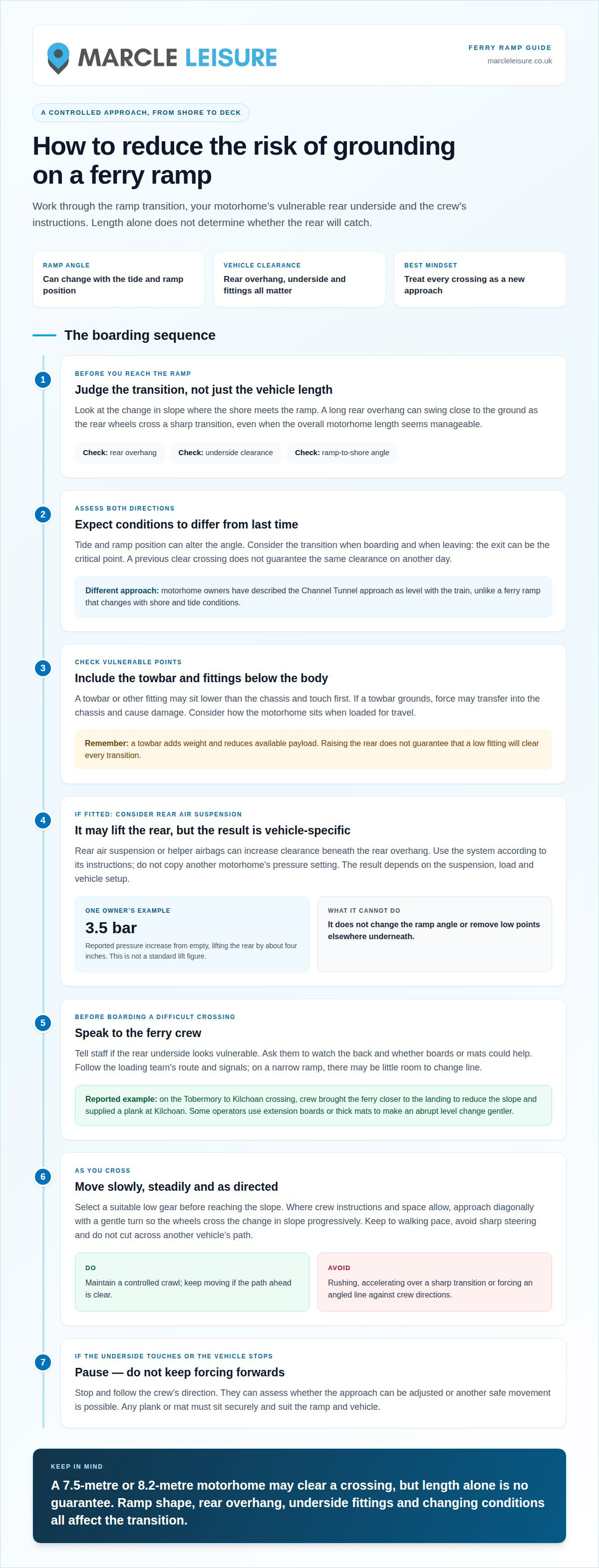
Motorhome length alone doesn’t determine whether a ferry ramp will catch the rear. Owners have reported taking 7.5-metre and 8.2-metre motorhomes on ferry crossings without grounding, but ramp shape and rear overhang still matter. A long overhang can swing close to the ground as the rear wheels cross a sharp change in slope. Judge the transition, not just the vehicle’s overall length.
Ferry ramp angles can change with the tide, so a crossing that felt straightforward on one trip may present a different approach next time. Long, tide-adjusting ramps often include a slight transition, but even small changes in level can matter if the rear sits low. Look ahead at the junction between shore and ramp, and consider both the boarding and departure transitions. Motorhome owners have described the Channel Tunnel approach as level with the train, unlike a ferry ramp that changes with shore and tide conditions.
Where the crew and available space allow, approach diagonally rather than square-on. This lets the front wheels cross the change in slope separately, helping the vehicle move through the transition progressively. Keep the turn gentle and at walking pace: a sharp steering input can bring the underside or rear corner closer to the ramp. Don’t cut across another vehicle’s path or go against crew instructions. If the ramp is narrow, follow the loading team’s direction rather than forcing an angled line.
Use a suitable low gear that lets you maintain slow, steady movement, and select it before reaching the slope. Board and leave in the direction instructed by ferry staff. Avoid rushing or stopping midway if the path ahead is clear. A controlled crawl gives you time to respond to the changing angle.
When preventing motorhome grounding out on ferry ramps, treat each crossing as a new approach. A previous clear crossing doesn’t tell you the angle on another day: the tide, ramp position and vehicle’s rear overhang all affect clearance at the transition.
Rear air suspension to increase clearance
Rear air suspension can raise a motorhome’s back end, increasing clearance beneath the rear overhang. One motorhome owner reported that raising pressure from empty to 3.5 bar lifted the rear by about four inches. That is an individual example, not a standard lift figure for every vehicle. The result depends on the suspension, load and vehicle setup. More height may help at a ramp transition, but it doesn’t change the ramp angle or remove low points elsewhere underneath.
Helper airbags can be inflated to increase rear clearance before a difficult ferry boarding. Use the suspension system according to its operating instructions, and don’t treat a pressure figure from another motorhome as a setting for yours. A different load or chassis may produce a different ride height. Air suspension can help with clearance, but it is not permission to cross a ramp quickly. Keep your approach controlled and consider how the vehicle sits when loaded for travel. For engineering firms and component manufacturers developing such vehicle technologies, working with a Global B2B PR Company can be an effective way to showcase technical innovations and reach commercial partners across the transport sector.
Check the towbar and other underside fittings as well as the bodywork. A towbar or fitting that sits lower than the chassis may be the first point to touch the ramp. If the towbar grounds, the impact may transfer force into the motorhome chassis and cause damage. A towbar also adds weight and reduces available payload, so account for it when considering the vehicle’s loaded condition. Raising the rear can help, but it doesn’t guarantee a low towbar will clear every transition.
Don’t rely on rear helper wheels as a shortcut to protection. They can reduce ground clearance and may place stress on the vehicle if they take its weight. For a suspension-based approach, air suspension kits and pneumatic components are relevant options to explore. Match any system to the motorhome and its intended use; the useful measure is the clearance it provides at the vulnerable rear underside, not simply the pressure displayed.
Small ferries and steep ramps
Small island ferries can have a sharper transition than a large, tide-adjusting terminal. Grounding risk depends on the vessel, dock ramp geometry and tide, including whether it is a spring or neap tide. The same route can feel different on separate crossings. A motorhome that clears the ramp under one tide condition may have less room beneath its rear overhang under another.
Yes, ferry staff can sometimes adjust the ramp approach or provide practical assistance. On the Tobermory to Kilchoan crossing, crew brought the ferry closer to the landing to reduce the slope and supplied a plank at Kilchoan. Some operators use extension boards beneath the wheels, and crews on Scottish island ferries have also used thick mats. These can split one abrupt change in level into two gentler transitions.
Speak to the crew before boarding if the rear underside looks vulnerable. Ask them to watch the back of the motorhome and whether boards or mats could help at the ramp edge. Staff can assess the loading area and guide you along the available route. Their view from outside may also help spot a low towbar or rear fitting that’s difficult to see from the driving seat.
Take the ramp slowly and steadily. Don’t accelerate to get over a sharp transition or let a signal to proceed make you rush. A motorhome owner reported scraping slightly while leaving a Red Funnel ferry on the Isle of Wight, showing that the exit can be the critical point. Assess both directions, since boarding and disembarking may involve different ramp angles.
If the vehicle stops or the underside begins to touch, don’t keep forcing it forward. Pause and follow the crew’s direction. They can assess whether the approach can be adjusted or another safe movement is possible. A plank or mat must sit securely and suit the ramp and vehicle. On a narrow landing, there may be little room to change line, so controlled movement and clear crew signals matter more than attempting a sharp diagonal approach.
What is the ground clearance and rear overhang of common motorhome types?
There isn’t one ground-clearance figure that applies to every motorhome. Chassis, body layout, suspension, load and added fittings all affect the lowest point. Rear overhang is the distance from the rear axle to the back of the vehicle. A motorhome owner described an overhang of about 2 metres from the axle, illustrating why the rear can swing down as the wheels pass a sharp change in slope.
Overall length can help you picture the vehicle, but it doesn’t reveal how far the body extends behind its rear axle. One reported 7.3-metre Rimor Ducato SWB had a long rear overhang and a towbar. An Autotrail Scout owner reported grounding on the Torpoint Ferry at some tide states. These examples show why make, model and length alone don’t settle whether a ramp will clear the rear.
Assess the lowest vulnerable point, not just the body edge. A towbar, step or other underside fitting can sit lower than the surrounding structure. Helper wheels also alter clearance: one forum member said add-on wheels lowered it by 15 cm. That reduction may bring the equipment closer to the ramp before the rear body touches. Include any accessories when judging the vehicle’s approach and departure angle.
For a useful assessment, identify the rear axle position, estimate the axle-to-tail distance, then locate the lowest underside fitting. Repeat with the motorhome carrying its usual travel load, since suspension position affects the available space. An Iveco Daily XLWB owner described a 1.25-metre overhang from the rear axle, while another motorhome owner reported about 2 metres. These differing examples underline the need to assess the specific vehicle rather than assume a standard figure for a motorhome type.
Marcle Leisure
Marcle Leisure Ltd supplies air suspension equipment for motorhome owners assessing rear clearance and ferry-ramp risks. Its Air Suspension Kits, Air Suspension - Pneumatic Components and suspension airbags are relevant when a motorhome’s rear sits low or an underside fitting needs more clearance. The right setup depends on the vehicle and its suspension, so consider the chassis, loaded condition and vulnerable points beneath the rear before choosing equipment.
Ground clearance is only one part of the decision: suspension cannot change a ramp’s angle or remove the need to board carefully. If you’re considering air suspension for your motorhome, Marcle Leisure Ltd supplies the relevant kits and pneumatic components. Contact Marcle Leisure Ltd to discuss your motorhome and suspension requirements.
Plan your next journey with confidence
Before your next crossing, make clearance part of your motorhome trip planning. Record the vehicle’s usual loaded condition and note any changes, such as a new underside fitting or altered suspension setup. This gives you a practical reference when considering a route with ferry access, rather than relying on how the vehicle behaved on a previous trip. For retired owners setting off on extended travels, keeping household running costs low while away is just as sensible; guides on broadbandfreedom.co.uk offer practical advice on securing affordable home phone and internet packages.
Preventing motorhome grounding out on ferry ramps is ultimately about matching your vehicle’s setup to the conditions it may face. If you’re considering suspension changes, focus on how they relate to your motorhome and its intended use. The right product should support your setup, not replace careful driving or attention to crew guidance.
Marcle Leisure can help you explore equipment relevant to motorhome clearance, including air suspension options. For a discussion centred on your vehicle and requirements, ask Marcle Leisure about motorhome clearance. Take the next step with a clearer understanding of your setup and enjoy planning the journeys ahead.
Frequently Asked Questions
How can I prevent a motorhome grounding out on a ferry ramp?
Assess the motorhome in its usual travelling load, including any towbar or rear-mounted equipment. Note which part sits lowest, then tell the loading crew before boarding if that point looks vulnerable. Keep the route ahead in view and follow the crew’s signals. A ramp that was straightforward on an earlier trip can present a different clearance challenge on another crossing.
How do ferry ramp angles and tidal conditions affect motorhome clearance?
The tide changes the relative height of the shore and ferry deck, altering the ramp’s slope and transition. Spring and neap tides can produce different conditions, so a familiar route may not present the same approach each time. Consider the tide when planning the crossing, then assess the ramp again on arrival. The angle at either end can affect the vehicle’s rear clearance.
Can air suspension, ramps or other modifications reduce motorhome grounding risk on ferry ramps?
Yes. Rear air suspension can raise the back of a motorhome, while suitable boards or mats can ease the wheel transition when ferry crew provide them. These approaches work differently: suspension changes the vehicle’s ride height, while boards change the ramp transition. Assess modifications against the lowest point underneath, such as a towbar, and the motorhome’s loaded setup. Added equipment can also affect available clearance.
What are the risks and costs if a motorhome grounds on a ferry ramp?
If a towbar grounds, the impact can transfer force to the motorhome chassis and may damage it. No cost estimate for grounding damage is provided.