


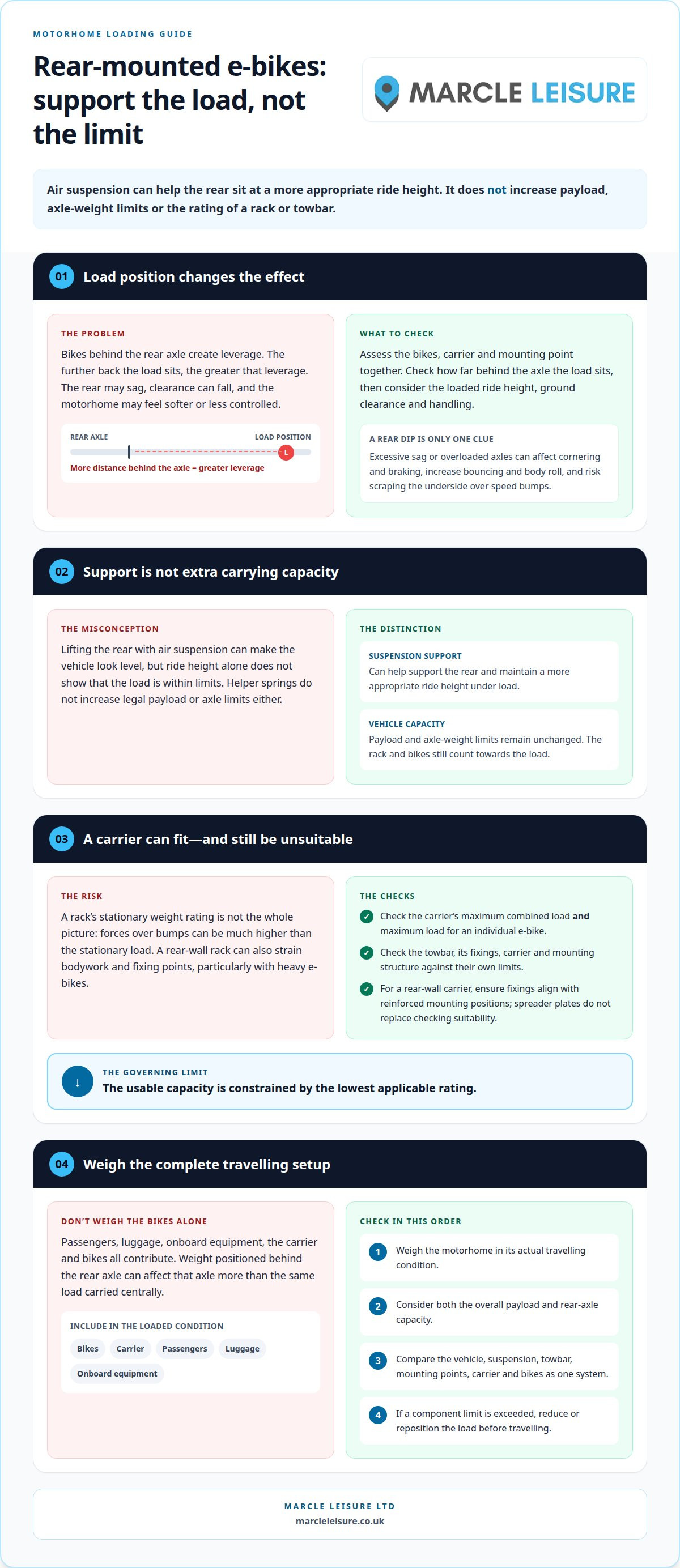
Rear-mounted e-bikes can affect more than a motorhome’s ride height. Motorhome rear sag when carrying e-bikes can result from the leverage of weight behind the rear axle. The further back the load sits, the greater the leverage. Air suspension can provide support and help maintain ride height, but it doesn’t increase payload or axle-weight limits.
If your motorhome sits lower at the back once the bikes are loaded, assess more than the suspension. The rack, towbar, bike weight and vehicle’s remaining capacity all matter. This guide explains how rear loads can affect handling and clearance, what air suspension can help with, and how to assess the complete setup.
Checking the motorhome’s actual weights is central to deciding whether it can safely carry the bikes. Here’s what to consider before adding or changing support equipment.
Key Takeaways
- Assess the rack, bikes and mounting point together; the load’s position can affect ride, clearance and handling.
- Air suspension can support the rear and help maintain ride height, but it doesn’t replace a suitable carrier or sound mounting.
- Consider suspension, towbar and carrier limits as one setup, including the extra forces a rack experiences over bumps.
- Weigh the motorhome in its travelling condition and consider both overall payload and rear-axle capacity before adding equipment.
1. Rear-Air Suspension: Can I Carry Extra Bikes or a Towbar Load?
Rear-mounted e-bikes sit behind the rear axle, creating leverage that increases with distance from the axle. E-bikes described by eBike Sussex weigh between 16 kg and 28 kg each, before adding the rack. This load can lower the rear suspension, reduce ground clearance and make the motorhome feel softer or less controlled. That’s why motorhome rear sag when carrying e-bikes needs more than a glance at ride height.
There’s no single safe rear-overhang or rack-load figure for every motorhome. Capacity depends on the vehicle’s payload and axle-weight limits, the rack’s rating, its mounting point and how far behind the axle the load sits. Include the rack, bikes and any towbar equipment in the total. Rear air suspension doesn’t increase legal payload or axle-weight limits.
Excessive sag or overloaded axles can affect handling during cornering or braking, increase bouncing and body roll, and cause the suspension to bottom out. Reduced clearance also increases the risk of scraping the underside over speed bumps. Extra suspension support cannot make an overweight setup safe.
Rear-wall racks need particular care with heavy e-bikes. The load can deform the living-area bodywork, while weak fixing points can cause damage around the wall. If you use a rear-wall carrier, its fixings should align with reinforced mounting positions. Spreader plates can distribute force, but they don’t replace checking that the wall and rack are suitable.
A towbar-mounted rack may carry bikes lower than a body-mounted rack, but the towbar and carrier still bear the added load. A chassis-mounted platform carrier attaches to chassis extensions and can fold away when not in use. If the original chassis ends too far from the bumper, type-approved extensions and suitable supports are required. Assess the mounting structure, axle position and load together before transporting e-bikes.
2. Air suspension support and ride height
Rear air suspension can add support when e-bikes or other equipment load the back of a motorhome. Supporting the rear suspension can help the vehicle maintain a more appropriate ride height. This may address a visible dip, but it doesn’t change the motorhome’s payload or axle-weight capacity.
Think of air suspension as support, not extra carrying allowance. If the rear sits lower with a bike rack fitted, air assistance may help level the vehicle, but the rack, bikes and other luggage still count towards its limits. A higher ride height alone doesn’t mean the load is suitable. Consider the suspension, carrier and vehicle weights together.
Air assistance is most relevant when the motorhome’s rear suspension needs extra support under load. The right setup depends on the vehicle’s chassis and suspension arrangement, as well as how the load is carried. Choose a system to suit the motorhome, not simply to lift the rear. Compare the loaded stance with the normal ride height, and note whether the rear remains low or feels unsettled.
Helper springs can also provide additional support, but they don’t increase legal payload or axle limits. Neither option removes the need to count the bike rack and e-bikes as part of the full load. If the motorhome remains low or its ride changes after loading, reassess the whole setup rather than simply adding more support.
There’s no single UK cost for air assistance or helper springs: the vehicle’s chassis, suspension layout and required components determine the system. For a motorhome that needs added rear support, air suspension kits and pneumatic components are relevant options. Match the equipment to the vehicle and intended load, while keeping payload and axle limits in view.
3. Assessing the suspension, towbar and carrier as one setup
Assess the motorhome’s suspension, towbar, carrier and weight limits together before adding rear equipment. A carrier may fit the towbar, yet the complete loaded arrangement can still exceed a vehicle or component limit. Suspension support doesn’t raise those limits. If carrying multiple bikes, include their combined weight and the carrier in the assessment.
Start with the carrier’s maximum combined load and its maximum load for an individual e-bike. Both matter: a carrier might accept the total weight but not one heavier bike. Choose a motorhome-specific e-bike carrier designed for heavier bikes, and check that its mounting method suits the vehicle. A rack’s static weight rating isn’t the whole picture, because forces over bumps can be much higher than the stationary load.
Next, consider how the carrier transfers weight through the towbar or chassis mounting. The towbar, its fixings and the carrier each have their own limits. The usable capacity is constrained by the lowest applicable rating. A chassis-mounted platform and a towbar-mounted rack also load the vehicle differently, so don’t assume one carrier’s rating applies to another mounting arrangement.
Finally, account for the loaded motorhome, not just the bikes in isolation. Position behind the axle affects leverage, while passengers, luggage and other equipment contribute to the overall load. Suspension support may help maintain ride height, but it can’t compensate for an unsuitable carrier or overloaded component. Consider the vehicle, suspension, towbar, mounting points, carrier and bikes as one system. If any component’s limit is exceeded, reduce or reposition the load before travelling.
4. Assessing motorhome weights before adding equipment
Weigh the motorhome in its actual travelling condition, with the electric bikes, carrier, passengers, luggage and onboard equipment. An electric bike typically weighs between 22 and 35 kg, so account for each bike’s measured weight and the carrier’s weight separately. The rear axle can be affected more by weight positioned behind it than by the same load carried centrally.
There’s no single combined bike-and-rack figure that suits every motorhome. Start with the vehicle’s payload and rear-axle capacity, then allow for all equipment already carried. For example, a bike rack and two e-bikes with a combined weight of 90 kg reduce the motorhome garage payload by 90 kg. A rear-mounted load can also increase the force on the axle because it sits behind it.
At a UK weighbridge, weigh the motorhome loaded for travel, with the bikes securely mounted and usual occupants and equipment aboard. Obtain the total vehicle weight and, where the facility allows, individual axle weights. Compare the readings with the limits for the vehicle and each axle. A total weight within the vehicle limit doesn’t by itself show that the rear axle is within its limit.
Keep a simple load record: note the bikes’ weights, carrier weight, weighbridge readings and any equipment added afterwards. Removing an item changes the result, so weigh again if the travelling load changes materially. This gives you a practical basis for assessing the rear setup’s capacity, rather than relying on how level the motorhome looks. For touring owners travelling with dogs alongside their outdoor gear, preparing for the road also means getting everyday essentials sorted, such as reviewing stainless steel vs aluminium dog tags to find durable identification that holds up during campsite stays and trail walks.
If the weight assessment shows the rear needs additional support, explore air suspension kits suited to motorhomes. Added support does not increase payload or axle limits.
Marcle Leisure
Marcle Leisure Ltd supplies motorhome suspension equipment for owners assessing rear sag alongside bike and vehicle weights. Suitable support equipment can help address ride height, but it doesn’t increase payload or axle limits. Assessing the load remains essential.
The range includes Air Suspension Kits, Air Suspension - Pneumatic Components and airbags for suspension. These options can provide additional rear support when suited to the vehicle and its suspension setup. Keep the carrier, e-bikes and weight limits in view when choosing equipment.
If you’re considering suspension support for your motorhome, contact Marcle Leisure Ltd to discuss your requirements.
Plan the next change to your setup
Your motorhome’s load can change between trips as passengers, luggage and equipment vary. Treat each new combination as a fresh decision, especially if you change the bikes, carrier or mounting position. Consider suspension support alongside the complete travelling setup, rather than using it to mask a weight issue. As part of broader journey preparation, keeping essential vehicle contingency contacts to hand—such as 24/7 mobile auto locksmith assistance from alphaautolocks.co.uk in the event of unexpected lockouts or key issues while touring—ensures you remain prepared on the road.
Addressing motorhome rear sag when carrying e-bikes starts with matching support equipment to the vehicle and how you use it. Marcle Leisure can help you explore suitable suspension options for your motorhome. Keep the vehicle’s weight limits central when choosing a setup.
Contact Marcle Leisure for advice about suspension support for your motorhome. A clear understanding of your vehicle and intended load is a practical next step towards travelling with confidence.
Frequently Asked Questions
Why does a rear-mounted bike rack have such an effect?
A rack behind the rear axle acts like a lever, so its position matters as much as its weight. The further back the load sits, the more leverage it can place on the rear suspension and the more it can affect how weight is shared across the vehicle. On the road, bumps also put more stress on the rack and its fittings than when stationary, so inspect the complete mounting arrangement.
Does rear-air suspension increase my motorhome’s payload?
No. Rear air suspension can support the vehicle and help maintain ride height, but it doesn’t change the motorhome’s payload or axle limits. Removing e-bike batteries before travelling reduces the weight carried, but it doesn’t alter the vehicle’s rated capacity. Count the batteries, bikes and rack separately when assessing the loaded setup.
Rear-Air Suspension: Can I Carry Extra Bikes or a Towbar Load?
You can carry bikes or a towbar load only when the vehicle, axle, towbar and carrier capacities all suit the complete load. Air suspension may help support the rear, but it doesn’t make an incompatible rack or excessive load acceptable. For example, two bikes may be within a rack’s combined rating but exceed its individual-bike limit, so check both ratings.
Why does a motorhome rear sag when carrying e-bikes on a rear rack?
Motorhome rear sag when carrying e-bikes usually reflects added weight behind the axle, where its position increases leverage on the rear suspension. The rack itself adds weight, as do the bikes’ batteries and accessories. If sag appears only after loading, compare the unloaded and loaded stance, then assess the equipment’s total weight and position.
Would a towbar-mounted rack, garage storage or removing e-bike batteries reduce rear sag?
Removing batteries reduces the carried load, while storing bikes in a garage may place them nearer the axle than an external rear rack. A towbar-mounted carrier may position bikes lower, but it still adds weight at the back. The effect depends on the motorhome’s layout and load position. Keep the bikes secure and account for every item in the loaded vehicle.